This is an old revision of the document!
Stages Assistant Configuration
The Stages Assistant is a chatbot that uses Generative AI to answer all kinds of questions using the process content defined in Stages.
You can find more on its basic usage and functionality here.
The sections below describe how to set up, train, and maintain the Stages Assistant.
Acknowledgement of AI-enabled Features
The Stages Assistant uses Generative AI to implement its various capabilities. Although our implementation aims to minimize mistakes through the use of knowledge-graph technology, AI-based systems can be imprecise or incorrect, a phenomenon usually known as “hallucinating”.
To make users aware of this fact, each user is required to accept an AI disclaimer before first use.
See here for more info on this subject.
Views and Workspaces
Processes in Stages exist in many different versions, workspaces, variants, and process instances. AI technologies work best if the scope of the underlying information is clear and well-defined. Combining different process versions, variants, and instances would result in imprecise or even misleading answers. Therefore, multiple Stages Assistants can be defined, one for each view on the process landscape.
Possible process views are:
- Standard processes that everyone should follow
- Process variants, e.g. a development process for normal products, one for safety-critical products, one of cybersecurity-critical products, and one for both safety- and cybersecurity-critical products
- Processes that are especially tailored for specific programs or projects
Views can consist of a single workspace or a collection of workspaces. This way, the standard process view can consist of a workspace containing the standard development process, one or more workspaces containing all organizational processes that are not executed by projects or product teams, and a workspace containing the organizational policies.
Stages Assistants are always trained on the Valid Version of the process content in each workspace. This version must be different than the Working Version.
Required Permissions
End users require the following permissions to use the Stages Assistant:
Chatbot: ReadWorkspace: Read
To configure the AI assistants, the following permissions are needed:
AI Administration: RCMDWorkspace: Read
In both cases, the permission scope must include the workspaces for the defined view. If the view includes a workspace collection, the permissions must apply to all workspaces within the collection.
In the Assistant, users will only see the views for which they have read permissions.
Configuring the Stages Assistant
Configure the Stages Assistants in the Administration > AI > Chatbot menu. The main screen shows the currently configured assistant views.
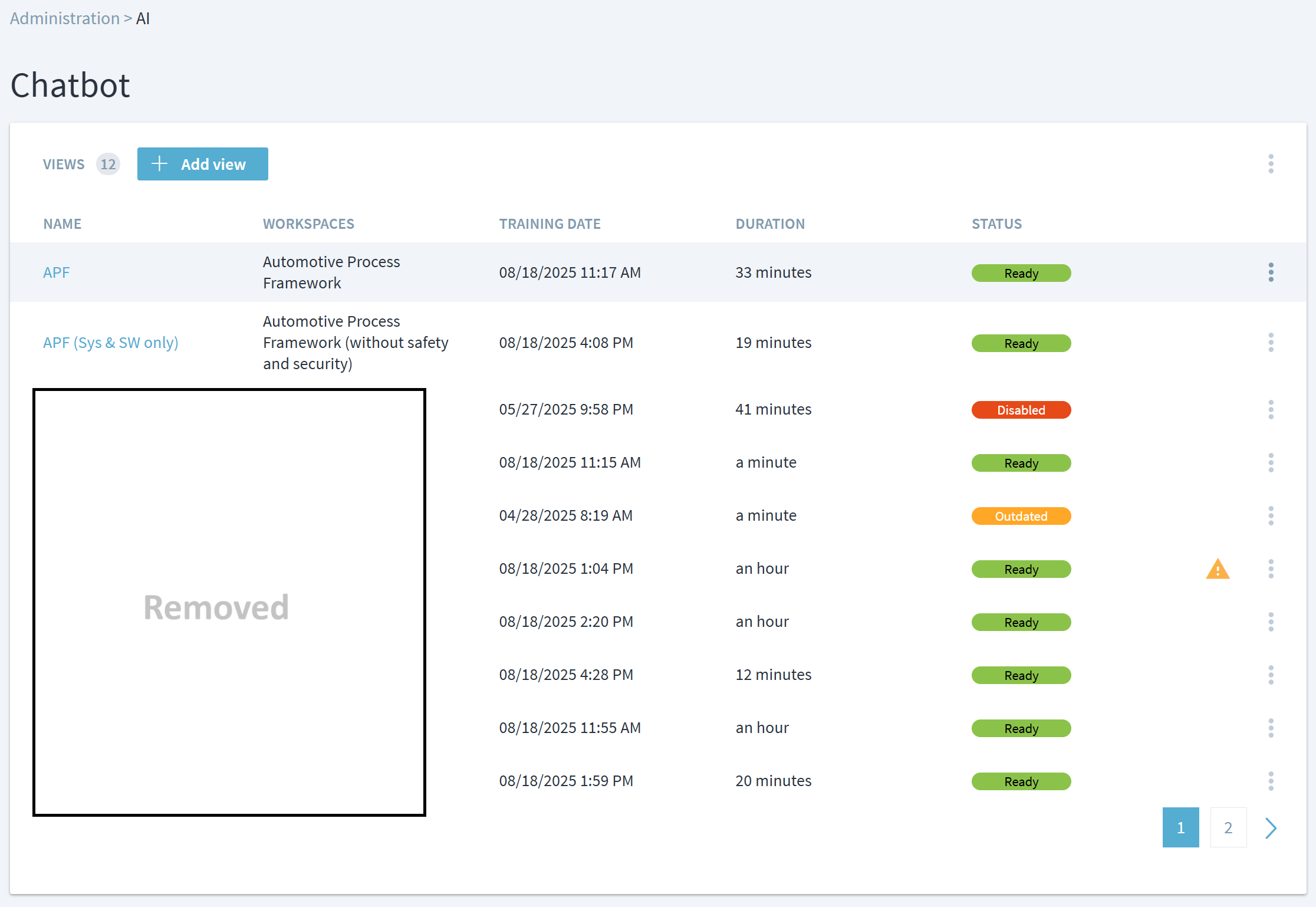
In addition to the name, you can see the following information for each view:
- Workspace or collection assigned to the view
- Time and duration of last training run
- Status:
- Ready: assistant view is fully trained, enabled, and can be used by end users
- Disabled: assistant view has been disabled or is not trained yet
- Outdated: assistant view can be used for end users, but a newer valid version of one of the workspaces was released since it was last trained. Depending on the training configuration (see below), the view will either be automatically retrained or needs administrators to manually start the training.
- Warnings that occurred during training, e.g. missing properties. If those warnings persist, please contact Stages Support or your Stages consultant.
Use the 3-dot menu to the right of the view to:
- Edit the view configuration
- Rename the view
- Assign or change the workspace or workspace collection (see above for details)
- Start training
- Delete the view
- Enable/disable the view
Clicking on the view name or selecting the Edit action opens the following configuration screen:
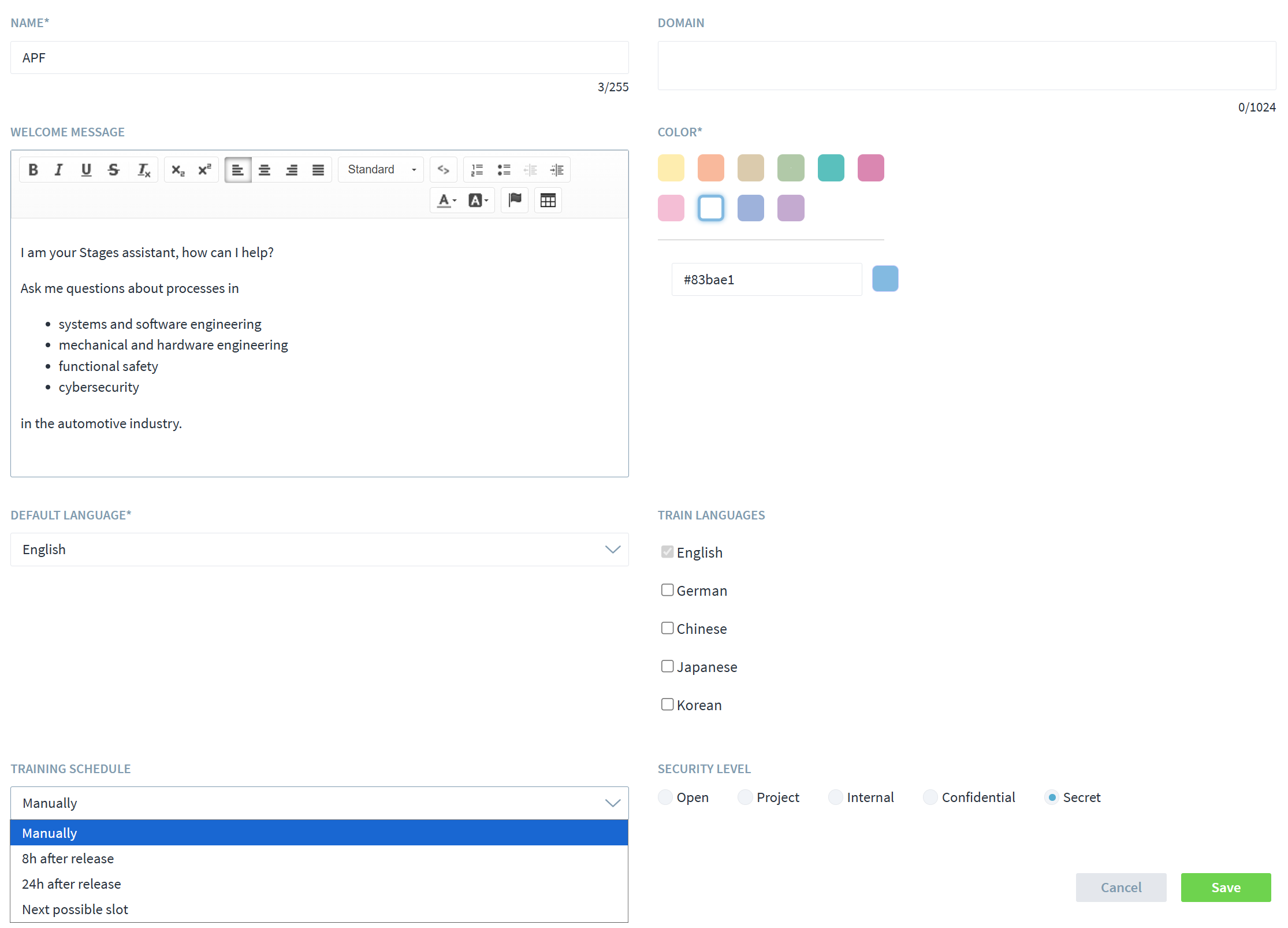
In the configuration screen, you can modify:
- Name of the view
- Welcome Message that end users see when they access the view in the Stages Assistant. The message should describe the scope of information the Assistant can answer questions about.
- Color used to display user questions in the Assistant, so users can visually distinguish between different views
- Default and trained languages. Please note that each language is trained separately, so enabling multiple languages increases the training costs. Most AI language models are capable of automatically detecting the language of the user questions and providing answers in that same language without requiring separate training. Separate trainings for each language are only required if the process content is different in each language, e.g. specific for certain regions.
- Training schedule, whether training should be run manually or automatically when new valid process versions are released. For workspace collections, where you might be releasing multiple processes within a short time, the 8 or 24-hour delay reduces duplicate training runs.
- Security level required by end users to access the view, if applicable.
Please note: You must successfully train and then enable each view in order for end users to access it.
Acronym Handling
The assistant needs to be made aware of company-specific acronyms that are not described in the process models.
To manage those acronyms, a Stages administrator with edit permission in the new “Acronyms” domain can access the table via Administration > Acronyms.
For each acronym, its actual expansion and a longer multi-language explanation can be maintained.
For mass updates, an import and export of CSV files can be accessed via the “…” menu.
Limitations
The context window of the used AI Large Language Models (LLMs) is subject to limitations. To accommodate those limits, the process models are never sent to the LLM in their entirety, but only in select segments that are required to answer the user questions. As a consequence, questions that address whole process models, e.g. “List all work products of all processes”, currently cannot be answered.
During the training of the assistant, all process elements are transformed into a knowledge graph and stored in special databases. The following elements are currently excluded in this transformation:
- landing pages
- process start pages
- “comment only” associations
- descriptions that are managed via “
Management > Descriptions” (except for the inlined ones) - graphics that are embedded in element descriptions
- custom element attributes
- compliance mappings
- user-role associations
- project files
It is planned, to include those elements in future revisions of the assistant training scripts, if those improve the quality of the given answers.
Process interfaces to elements outside of the training view (workspace or workspace collection) are ignored.
To customize the trainings scripts, please contact the Stages support team or your dedicated Stages consultant.